

Background
A Green Take on our Proud History
Brilliant Minds for a Bold Mission


For decades we built and operated complex offshore systems, moving energy as liquids across oceans. EnviroShips extends that capability into a new era, using the same engineering DNA, but different liquid, delivering clean power for the future, instead of hydrocarbons.
HISTORY
The Deaner Family Shipping History began in the mid-1980s, when our saturation-diving experience enabled us to develop, design and finance a new generation of Diving Support Vessel (DSVs). Over this period, we delivered a fleet of seven DSVs, together with three semi-submersible floating-production platforms, including what was, at the time, the largest in the world. We were also the pioneering force behind the world's first floating-production system that we developed, designed and delivered for a marginal oil field in the harsh environment of the North Sea.
Having built more than $1 billion USD of offshore marine infrastructure assets, we developed the engineering know-how and financial expertise that now underpins our transition into a clean energy transport future.
The same techniques once used to unlock remote oil fields are now being applied to unlock the millions of Megawatt-hours of renewable energy being wasted by global electricity transmission networks.
Through the late 1990s and 2000s, we continued deploying critical offshore assets using proven international financing structures, including those supported by EU government guarantees. During this period, we helped establish industry-leading frameworks for offshore safety, regulatory compliance, port-infrastructure procedures and maritime-classification and certification standards. Our achievements were recognised with the Queen’s Awards for Industry, reflecting our enduring contribution to UK maritime innovation.
With this long track record, together with a further 150 years of combined marine-energy and financing experience, we began, over a decade ago, to develop the next chapter in floating energy systems: Floating Capture, Transport and electricity Regeneration vessels, known as EnviroShips.
These vessels build on the same core principles that defined floating production, but re-applied to the clean energy era.
Because we were the inventors of floating production, we recognised early on that the same principles could help solve one of today’s most serious energy challenges - transporting clean electricity. The EnviroShips programme was conceived to capture, store, transport and regenerate clean power at scale, providing a floating alternative to blocked grid.
Today, we are re-deploying our heritage in offshore development, maritime engineering and large-scale project financing to deliver low-carbon solutions. Our experience across multiple sectors provides a robust platform for next-generation clean-energy infrastructure that is practical, bankable, safe and globally scalable.
Through EnviroShips, we are bringing proven real-world execution capability to the challenge of transporting and delivering renewable electricity wherever it is needed most, helping accelerate the clean-energy transition.


Diving into a lifetime’s experience: born in the hostile depths of the North Sea where engineered breathing systems kept divers alive under crushing pressure. Today the same logic applies to the grid network: the pressure is rising, the system needs to breathe, and EnviroShips provide the mechanism by absorbing excess wind, transporting it, and releasing power on demand.
SATURATION DEEP-SEA DIVING
Martyn Deaner, a pioneering deep-sea saturation diver at the height of the North Sea oil boom in the 1970s, operated in the hostile darkness 300–700 ft below the surface across first-generation fields including Forties, Ninian, Magnus, Claymore, Piper, Brent, Beatrice and Auk. This was the raw birth of subsea construction; freezing black water, brutal storms, experimental equipment and absolutely no forgiveness for mistakes. Life support depended on discipline, and Martyn often worked alongside elite U.S. Navy SEAL dive teams where trust, steel-nerved calm, and flawless procedural sequencing meant coming home alive. It was a world that shaped him forever, teaching the lessons of pressure, reliance on a highly qualified team, and exhaustive planning that now underpin the engineering principles he brings back to the surface.
SATURATION DIVING SYSTEMS
Offshore Marine Engineering (OME), owned by the Deaner Family Shipping Trust, designed and supplied twenty-four advanced split-level saturation diving systems for deepwater offshore operations. Each ~£8 million system included deck decompression chambers, full life-support, diver accommodation, gas management, bell handling, and umbilical systems. Over 30 units were delivered globally to major operators, installed on semi-subs, work-over rigs, and Diving Support Vessels (DSV). Engineered for up to 18 divers at depth, OME’s systems became industry standards for safe, and continuous subsea intervention.


AQUA HYPERBARIC LIFEBOAT
OME's Aqua Self-Propelled Hyperbaric Lifeboat was a revolutionary safety breakthrough in the mid 1980's, OME developed and built the world first
enclosed-hyperbaric lifeboat capable of evacuating saturation divers directly from the chamber in a full-pressure, life-supporting environment during an offshore emergency. Designed for use on DSVs, platforms and rigs, it could rescue up to 12 divers in saturation in a single incident, a life-saving capability that had never existed before. The invention earned OME the Queen’s Award for Industry, presented personally to John Deaner by Queen Elizabeth II at Buckingham Palace. Beyond offshore safety, the same hyperbaric systems were later adapted for medical use, including installation at hospitals such as Aberdeen Royal Infirmary.

SHEARWATER SAPPHIRE
The Shearwater Sapphire was the first in a landmark series of seven state-of-the-art DSVs built to support the emerging deepwater construction and saturation diving industry. Constructed at the De Hoop Shipyard in the Netherlands, the project was financed through a pioneering structure combining Dutch Government grants, the Netherlands Ship Mortgage Bank, NESAC mezzanine financing, and the sale of integrated saturation diving systems. Critically, Shearwater Sapphire was among the very first commercial vessels in the world to operate using a dynamic positioning system, the Kongsberg 503 Mk.2 DP system, at a time when DP was still experimental in offshore operations. Shearwater Sapphire was an early adopter and advocate of the technology, helping prove its reliability for subsea construction.

SHEARWATER TOPAZ
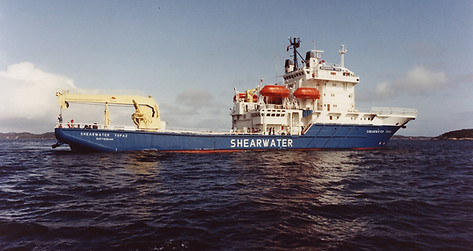
Shearwater Topaz was the second vessel in the Shearwater DSV fleet, ordered as an option ship after Lyle Shipping recognised a second hull and secured a five-year subsea contract opportunity. Built at De Hoop and launched on 1 May 1982, the vessel was acquired for around $30 million USD, reflecting strong demand for advanced subsea tonnage. Designed around its 18-man split-level saturation diving system, the Topaz offered significantly improved safety, endurance and subsea capability during the early expansion of the North Sea sector. Today, the vessel lives on as Seamec II, operating under Indian flag and still active more than 40 years after delivery, a testament to the soundness of its engineering and the foresight.
DEEPWATER 1
Deepwater 1 was the first of the Deepwater Series. A next-generation Mark II DSVs funded directly by the recovery of 431 bars of Soviet gold from HMS Edinburgh. Built with Wharton & Williams, the vessel advanced beyond the original Shearwater designs with greater length, deeper diving capability and far stronger system integration. It also introduced a world first: the self-propelled hyperbaric lifeboat (SPHL), approved for North Sea service in 1981, capable of evacuating 12 saturation divers 100 m from the vessel in under six minutes. The vessel was purchased with a price tag of ~$35m, together with her sister by Brown & Root Halliburton, it remains a symbol of engineering built to last. It was a vessel born of gold, and built to go deeper, far-deeper than convention allowed at the time.

DEEPWATER 2
The Deepwater 2 together with her sister was financed not by banks or oil companies, but by some of the gold salvaged from the wreck of HMS Edinburgh, a Royal Navy cruiser torpedoed and sunk by a German U-boat in the Barents Sea in 1942. Lying at ~800 ft, right at the edge of saturation diving limits, the salvage operation pushed human endurance to the extreme. Divers could only work minutes at a time, using early deep-heliox procedures, and every party involved , including the vessel owner, worked on a “NO GOLD, NO FEE” basis. The reward was extraordinary: 431 bars of Soviet gold recovered, with some of the bars being legally channelled through capital-allowance tax structures to fund the construction of the Deepwater Series. A $35,000/day vessel suddenly earned 8× its day rate, and a fleet was born. Mother and Baby doing well!

ENERGY SUPPORTER
The Energy Supporter was a pioneering British offshore support vessel, designed and delivered under the leadership of Martyn W. Deaner and launched by his wife, Ursula Deaner. Built during the height of North Sea development, it was engineered as a true multi-role platform, combining subsea construction, heavy lift capability, field maintenance and well-support functions in a single vessel. With a large working deck, powerful cranes and advanced propulsion for station keeping, it set a new benchmark for flexible offshore operations. More than an asset, the Energy Supporter established the Deaner family’s engineering pedigree and laid the foundation for the philosophy behind EnviroShips today.

HSwMS BELOS
HSwMS Belos (A214) began life as the Energy Supporter, built in 1985 at De Hoop Shipyard in the Netherlands and delivered to the Deaner family’s Energy Supporter Shipping. In 1992, the Swedish Navy acquired the vessel and undertook a major conversion to transform her into one of the world’s most capable Submarine Rescue Vessels (SRV). The refit added a Transfer-Under-Pressure (TUP) system, hyperbaric chambers, advanced diving and ROV equipment, a 100-tonne crane and later a 55-tonne A-frame, along with upgraded station-keeping and azimuth thrusters for precise hover operations. Today, Belos serves as Sweden’s primary NATO-compatible SRV, and played a critical supporting role in the early multinational response to the sinking of the K-141 Kursk Submarine in 2000.

STENA MAYO
Built in 1987 by Euroflex Marine, Aarhus (Denmark), the Stena Mayo is a highly capable subsea support and light-construction vessel, purpose-built for deep-diving operations and harsh-environment offshore work. Outfitted with a saturation diving system, work-class ROV capability, and long-endurance station-keeping equipment, the vessel quickly became a mainstay in complex subsea intervention campaigns across the North Sea and Arctic regions. The Mayo acted as the Command Ship, alongside the HSwMS Belos (also known for her involvement in the K-141 Kursk submarine recovery mission) in July 2001, where she supported inspection, diving logistics, and subsea coordination in the Barents Sea, demonstrating the reliability, engineering pedigree, and great resilience.

STENA MARIANOS
Built in 1987 by Euroflex Marine in Aarhus, Denmark, the Stena Marianos was a highly capable Mark I diving support vessel engineered for sophisticated subsea construction, inspection and intervention work. Equipped with a twin-bell,
16-man saturation diving system rated to around 230 metres, she quickly earned a reputation as a dependable deep-water asset in the North Sea and wider international markets. Among her notable early assignments was participation in the high-profile recovery of a Sikorsky S-61N helicopter fuselage in 1988, demonstrating her capability in complex offshore operations. Now operating under the name Mermaid Commander, she continues to serve in commercial subsea roles, a testament to her enduring design and engineering pedigree.

AMETHYST
Amethyst was a semi-submersible floating production and subsea construction platform developed at De Hoop Shipyard as a multi-role field-development vessel. Built around an 18-man split-level saturation diving system, she combined deck decompression chambers, life-support plant, bell-handling and umbilical systems with ample deck space for subsea hardware and well-support equipment. Amethyst worked as a construction and workover support unit on subsea installations, carrying out well stimulation, nitrogen injection, line proving and well-testing campaigns alongside heavy diving operations. The concept proved highly successful: the Amethyst design became a template for several follow-on units built for major operators, supporting field-development and intervention.

FLOATING PRODUCTION SYSTEM
The Deaner family pioneered the world’s first Floating Production System (FPS),
a breakthrough that replaced fixed jackets and topsides with a floating, seabed anchored production platform. Instead of piping oil through rigid structures, flexible risers carried hydrocarbons to the floating production unit, which then off-loaded to a dedicated storage tanker moored nearby for safety. From there, a shuttle tanker would load the crude and sail to the refinery in Hull, creating a fully mobile, marine-based field-development system. This ship-to-ship, floating-asset architecture became the foundation of modern FPSO operations. Its principles; mobility, flexibility, and offshore processing, now form the engineering DNA of the EnviroShips system, adapted for clean power rather than crude oil.

SPIRIT OF COLUMBUS
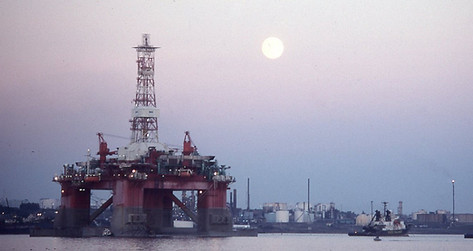
The Spirit of Columbus was one of the most ambitious floating production projects ever undertaken; 76.8% financed through Italian Government subsidies, paid semi-annually over 12 years. Costing approximately $400 million USD, she was the world’s largest Floating Production Facility (FPF) at the time of delivery by Fincantieri Genoa. Weighing over 35,000 tonnes LDT, the vessel was built modularly across six Fincantieri shipyards; Sestri-Ponte (pontoons and main deck), Riva Trigoso, Muggiano, Nuova OMA, and Livorno, before final assembly. Designed for deepwater fields up to 500m, she could produce 100,000 barrels of oil per day, treat 120,000 barrels of water per day, and export 100 MMSCF of gas daily. The platform incorporated state-of-the-art safety, processing, and marine systems, setting new global standards for floating production and was sold in 1996.


.png)